
Updates and announcements
New QuStream Paper Released Describing the Updated Algorithm
A new paper was finished in February but couldn't be released until the corresponding patent update submission was finalized and receipt acknowledged. This process took longer than expected but the new paper is finally here!
This marks the switch from the old approach (embedding key bits throughout the Q-block) to the new approach (sending an unmodified Q-block to both sender and receiver from which they independently derive the same key, meaning the key is not transmitted and therefore can't be intercepted).
If this sounds confusing or overly mysterious, read up on how QuStream works here for a better understanding.
The QuStream Node Network Is Live! (in test mode)
COO Ishiki Arata announced the deployment of the node network update to account.qustream.com. Node operators can now download the Docker image, generate API keys, and fire up their nodes on the live network. The network map offers a public, real-time view of active nodes globally. Nodes are actively routing QBlocks, with a proof-of-concept messaging app available to demonstrate QuStream encryption in action. The network is in test mode while remaining admin dashboard features are finalized; staking contracts on Solana are next in the pipeline.
The quantum security gap between theory and real-world deployment came into sharp focus this week. QuStream announced a strategic collaboration with a drone startup targeting the British Army, where its lightweight protocol eliminates the “power tax” that makes standard PQC unusable on wireless tactical drones. The same architectural advantage applies to smart metering: with over a billion meters globally incompatible with heavy PQC algorithms, QuStream's over-the-air firmware deployment turns a £200M truck-roll problem into a near-zero-cost upgrade. Underpinning both opportunities, the team confirmed the updated core US patent has reached Patent Pending status.
Read full thread →The £200M Security Hack: Saving the Global Grid
New research from Google has effectively validated QuStream's core thesis — the quantum threat is arriving ahead of schedule, and newly standardized Post-Quantum Cryptography is already showing cracks. This update from the QuStream team focused on a compelling commercial use case: smart metering infrastructure, where QuStream's lightweight symmetric architecture can be deployed via over-the-air firmware updates, avoiding the £200M cost of physical meter replacement facing UK utilities alone. The team also announced a NATO entry point through the Paris Defence Summit, with QuStream being introduced to QPrep — a group comprising heads of European national computing agencies — via the Nokia–Capgemini channel.
Read full thread →QSECDEF 2026 and more
QuStream dropped a brief update this week from the road — the team is bouncing between the Netherlands and Paris, with stops that included passing a third-party audit for a major data centre operator, an NDA signing with a drone chip vendor, and some defence networking at a quantum security conference.
Read full thread →Nokia Swiss Innovation Day Presentation
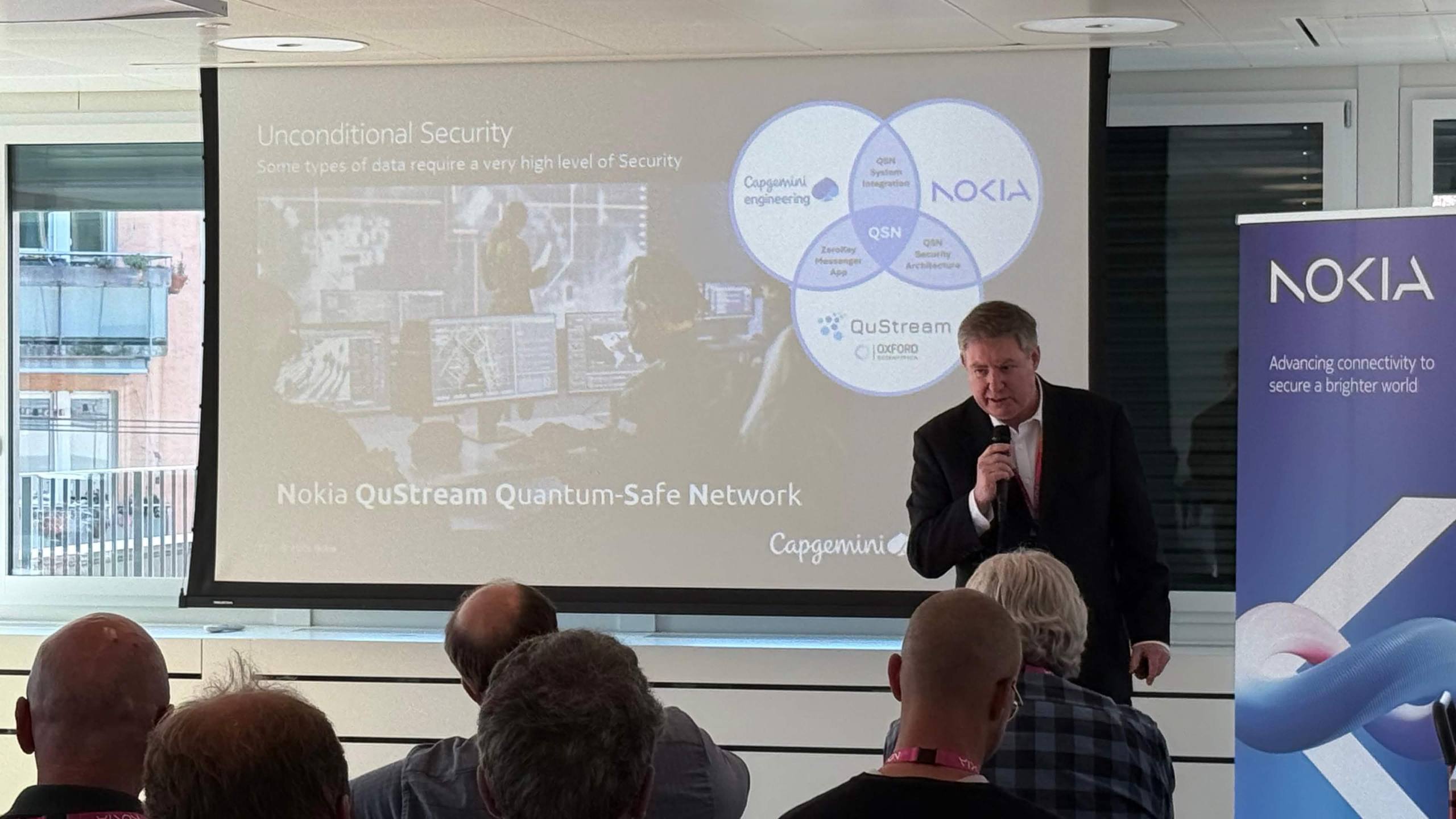
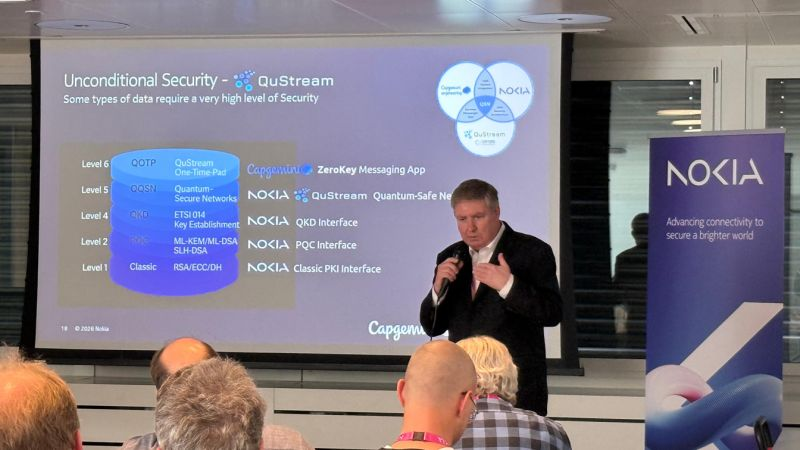
Adrian spoke on behalf of QuStream (his company) and Capgemini (his current employer) about QuStream's collaborations with Capgemini and Nokia on the QuStream Quantum Safe Network as a part of Nokia's Swiss Innovation Day 2026.
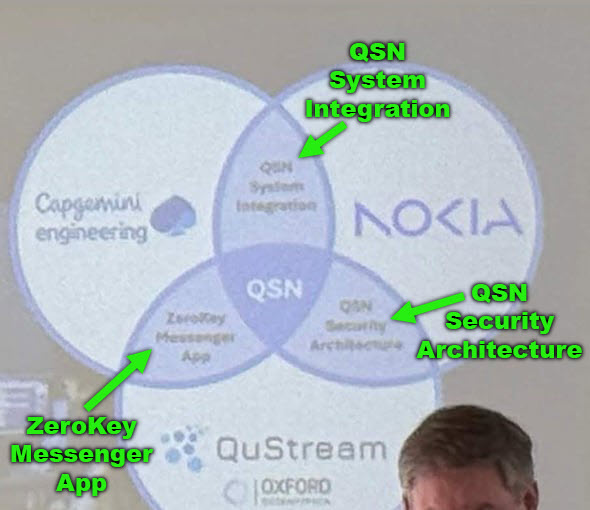
Note also Adrian's post on LinkedIn where he tagged a ton of people including several high-level Capgemini folks, and included pictures from the event calling out collaborative work between QuStream, Capgemini, and Nokia. While these companies haven't published anything about these projects yet online, it's hardly secret if they're talking about it at a public event.
A couple of interesting slides visible in the photos shared below — particularly on the zoom-in of the three-company collaboration Venn diagram, which includes a super-secure messaging app that Capgemini is developing using QuStream technology.
Nokia, Capgemini, and a stablecoin opportunity
Marking one year since the token launch, the team delivered a sweeping ecosystem update. Highlights include the transition to QuStream Version 2, a landmark partnership with Nokia and Capgemini to build a Quantum Network on Nokia's high-performance hardware, and a pipeline spanning sovereign defense contracts, central bank discussions, and stablecoin infrastructure.
Read full thread →The Shift to a Cipher Suite (QuStream SDK) and a Notable Potential Partnership
The team unveiled a strategic shift from a standalone algorithm to a comprehensive Cryptographic SDK, driven by the complex demands of defense and intelligence sectors. Also covered were updates to the core algorithm, revised presale pricing for Qube hardware, and the revelation that ongoing discussions with Capgemini include the possibility that Capgemini will accept QuStream equity in exchange for building out the SDK, forming the basis of a potential long-term development relationship in addition to the reseller arrangement that's already being considered.
Read full thread →In this session, the team announced a commercial development involving a strategic engagement with Colt Technology Services, a global Tier 1 telecom, fiber operator with a footprint in over 40 countries. Following a successful meeting in London, QuStream has been invited to install a permanent demonstration within Colt’s prestigious Innovation Lab where Colt's customers can evaluate the product for securing their communications.
Read full thread →The team solidified their operational infrastructure by announcing the formation of QuCloud, a strategic merger with Yoosend designed to manage the hardware backbone where each Qube will now support three nodes. Positioning the protocol as a "de facto" standard for high-security sectors, the team highlighted advanced negotiations with Capgemini supporting this mission. The update concluded with a clear Q1 roadmap, targeting a February kickstart for the node network and the imminent audit of staking smart contracts.
Read full thread →